

Bitcoin dropped 4% in the past 24 hours, revisiting the $66,000 zone for the first time since March 9.
Geopolitical tensions and recession fears are weighing on sentiment. But the more interesting story right now is not the price.
It is who is buying while everyone else sells.
The Bitcoin Whale Signal Is Real, But Incomplete
Large holders are accumulating. Bitcoin reserves on centralized exchanges fell to roughly 2.7 million BTC, the lowest level since 2019, according to CryptoQuant.
Coins leaving exchanges typically signal that investors are moving to cold storage and are not planning to sell. On Binance, large traders holding long positions in BTC futures have climbed toward 70%, the highest reading since late February.
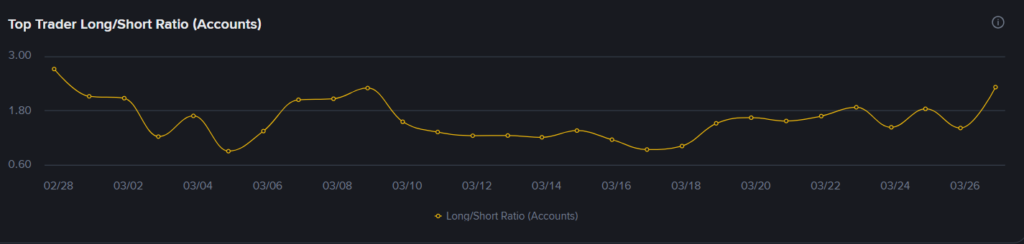
Santiment described the accumulation as “a promising sign of an eventual breakout from this range.”
That narrative holds until you look at what retail is doing at the same time. Addresses holding less than 0.01 BTC added 0.42% to their total balance over the same period, nearly matching the whale pace.
This matters because the most reliable bull signals historically emerge when large wallets accumulate while retail sells. When both sides buy together, the signal loses its predictive edge.
Whales absorbing supply is meaningful. Whales competing with retail for the same coins is a different story.
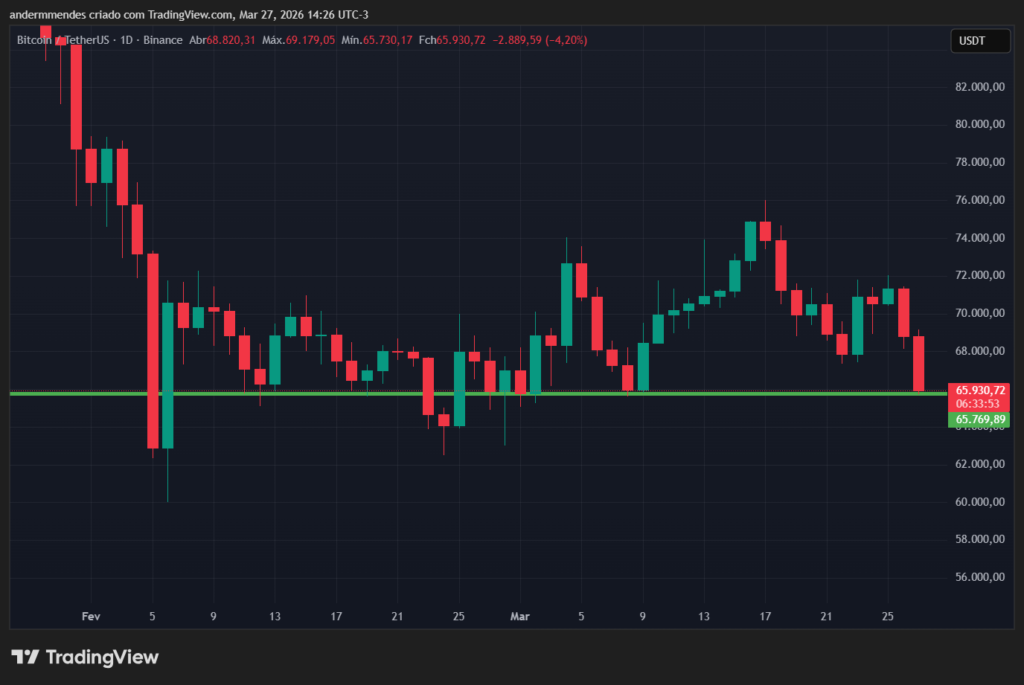
$66,000 Is Weakening With Every Test
Support levels are not static. Each retest consumes buying pressure, and $66,000 has now been tested multiple times in recent weeks.
The March 9 bounce was clean: buyers stepped in decisively and BTC rallied 15% in eight days. This retest looks messier.
Coinglass data shows sell orders outpacing buy orders by more than $2.7 billion across major exchanges in the past 24 hours.

That kind of order flow imbalance does not break strong support immediately, but it erodes it. A close below $66,000 opens $64,000 as the next reference, with $62,900 as the deeper target, a potential additional decline of 4.5% from current levels.
The whale accumulation is the one factor that could change this picture. If large holders absorb enough sell-side pressure before the weekend, the support holds and the setup resembles March 9 more than it currently does.
If they don’t, this retest ends differently than the last one.
Bitcoin is falling on Friday, March 27, due to a mix of external pressures. The Middle East conflict and fears of a global economic slowdown are dragging risk assets lower. Coinglass data also shows sell orders outpaced buy orders by more than $2.7 billion in the past 24 hours.
Yes. On-chain data from CryptoQuant shows Bitcoin exchange reserves have dropped to roughly 2.7 million BTC — the lowest since 2019. Large holders appear to be moving funds into cold storage, which typically signals long-term accumulation.
If Bitcoin loses $66,000 support, the next key levels are $64,000 and $62,900. That would represent an additional decline of up to 4.5%.